Academy Users Report / Vol.46

North China University of Technology
Traffic Behavior and Safety Research Laboratory,
The Beijing Key Laboratory,
Urban Road Traffic Intelligent Control Technology

To the Forefront of Advanced Traffic Control Systems and Safety Research
UC-win/Road Establishes Research Platform Integrating Real Roads with High-Precision VR

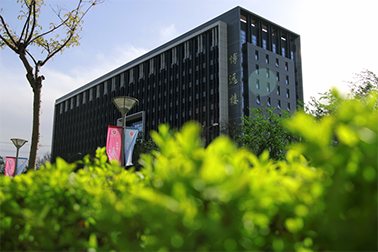
North China University of Technology
Traffic Behavior and Safety Research Laboratory, The Beijing Key Laboratory, Urban Road Traffic Intelligent Control Technology
URL https://www.ncut.edu.cn/
Location: Chaoyang, Beijing
Research contents: R&D of advanced traffic control technologies and systems Analysis and research of traffic big data. Traffic behavior and safety study.


Research on Driver Perception and Driving Risks and Development of Advanced Traffic Control Systems

The Beijing Key Laboratory of Urban Road Traffic Intelligent Control Technology is affiliated with North China University of Technology. It is a professional scientific research institution dedicated to urban intelligent traffic control and management. Its main research directions include traffic intelligent control technology, research and development of intelligent traffic control systems, traffic big data analysis and research, traffic behavior and safety research, etc.

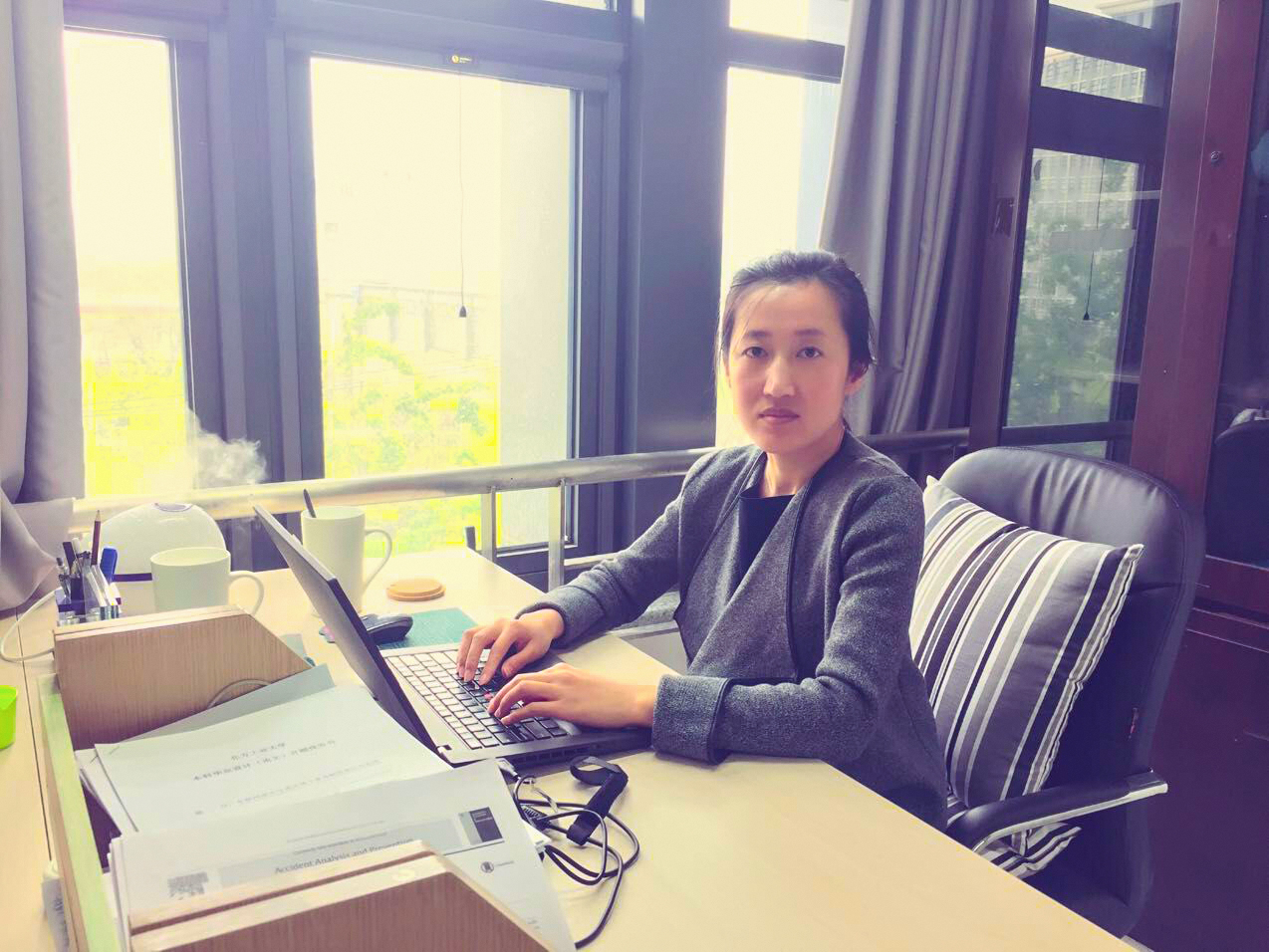
The Traffic Behavior and Safety Research Laboratory is affiliated with the aforementioned Beijing Key Laboratory. The research team consists of Associate Professor Guo Weiwei, Professor Tan Jiyuan, Associate Professor Xue Qingwan, and over 20 doctoral and master's students. Research directions include driver information cognition mechanism research based on human factors engineering, identification of driver's risky driving behavior characteristics, analysis and application of virtual reality driving simulation systems, research on traffic accident causation mechanisms based on traffic behavior identification, etc. The laboratory has led and completed over 30 research projects, including 2 National Natural Science Foundation of China projects, 3 sub-projects of National Key R&D Programs, and other ministerial/provincial-level projects. It has published over 70 papers, with more than 50 indexed by SCI/EI, applied for over 30 patents and software copyrights, and received 6 scientific and technological awards.

Associate Professor Guo Weiwei at The Traffic Behavior and Safety Research Laboratory


The Opportunity and Purpose for Introducing the UC-win/Road System

As the research deepened, the team accumulated a solid hardware foundation and data collection capabilities in driver behavior monitoring and vehicle real-road testing, gradually building the prototype of a traffic behavior and safety research platform. During this process, a core challenge emerged: how to deeply integrate and experiment with real driving behavior data, vehicle operational data, and a complex, highly reproducible, high-fidelity traffic environment with high degrees of freedom?

Whether exploring the mechanisms of driver physiological and visual characteristics, assessing the safety of road alignment and traffic facilities, or conducting human factors verification for future intelligent driving systems, a virtual testing ground capable of precisely simulating reality and allowing for editing of reality (e.g., changing weather, adjusting traffic signals, setting up unexpected events) was needed. At that time, the platform construction was at a critical stage. What the research team needed was not merely a 3D visualization tool for demonstration, but a simulation core capable of deeply participating in the scientific research workflow. It had to possess: high precision and flexibility, strong compatibility and extensibility, and comprehensive driving simulation support capabilities.

After rigorous evaluation of multiple domestic and international simulation software packages, the UC-win/Road system stood out due to its excellent 3D modeling capabilities, mature vehicle dynamics simulation support, good interoperability with various engineering software, and most crucially, comprehensive and open APIs (Application Programming Interfaces). It met the technical requirements for building a complete, closed-loop research platform encompassing scenario construction, behavior collection, and data analysis.

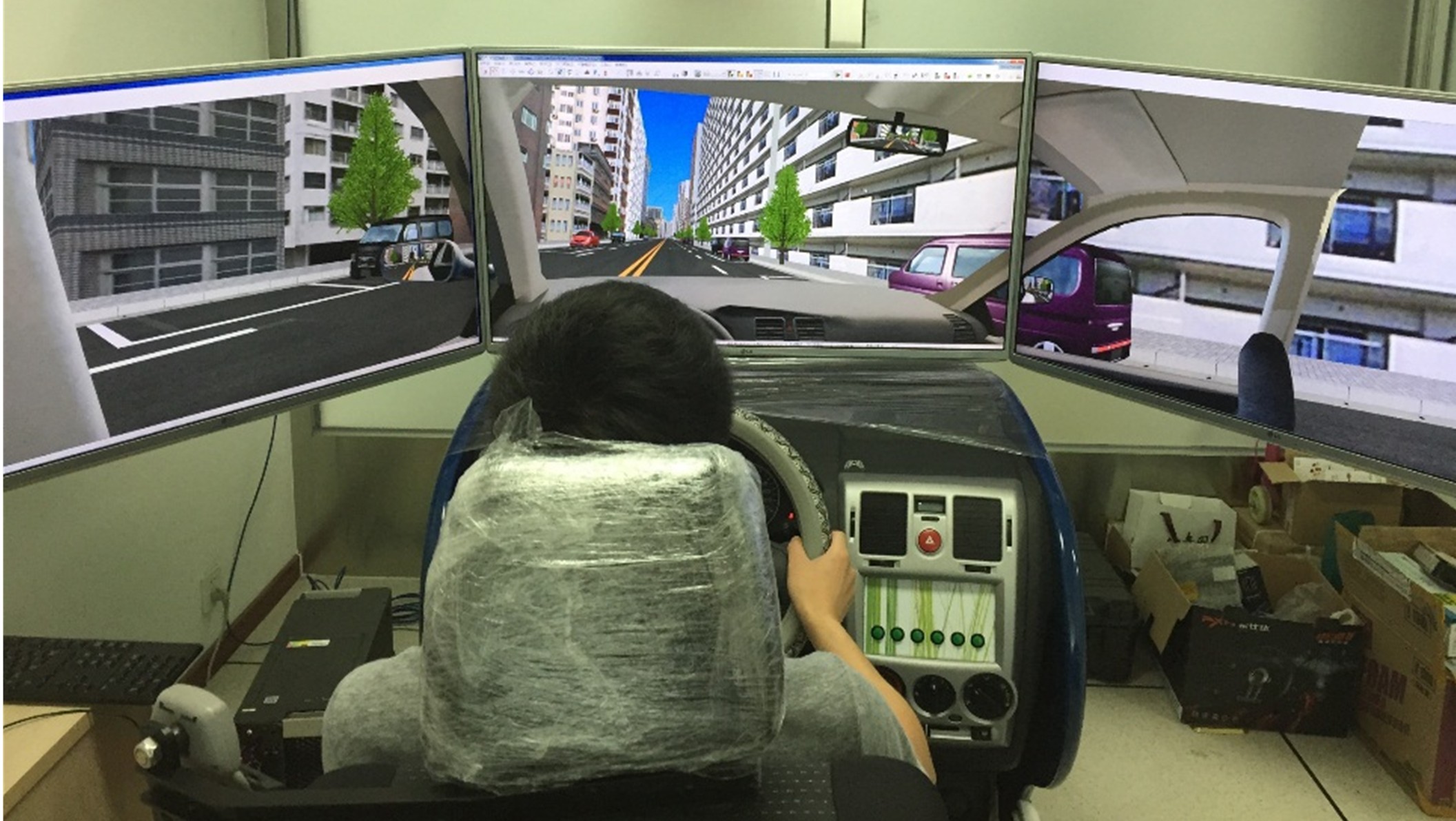
Driving simulator using UC-win/Road placed in the lab.


Introduced UC-win/Road Driving Simulator to Educational Curriculum

UC-win/Road upgrades traditional "armchair strategist" teaching to immersive experiential and inquiry-based learning, significantly improving teaching quality.

Reshaping Practical Components of Core Courses "Traffic Safety Theory and Technology"
Students no longer rely solely on 2D drawings to imagine 3D space. Using UC-win/Road, they input planar alignment, profile, and cross-section design parameters learned in the course to generate 3D road models in real-time. By driving through their own designed roads in the first-person view using a driving simulator, they intuitively experience the smoothness of alignment combinations, whether sight distances meet requirements, and the rationality of sign and marking placement. This "design-simulation-experience-optimization" closed loop allows students to deeply understand the safety and human-centric considerations behind design standards.

Graduation Projects / Comprehensive Course Projects
UC-win/Road has become an essential tool for students to complete complex projects. For example, in a project on comprehensive safety improvement design for a mountainous road section, a student team used the platform to restore the current situation of a black spot; they designed multiple improvement plans and recruited subjects to conduct driving simulation experiments within the unified virtual scenario, comparing and evaluating the effectiveness of each plan based on objective data.

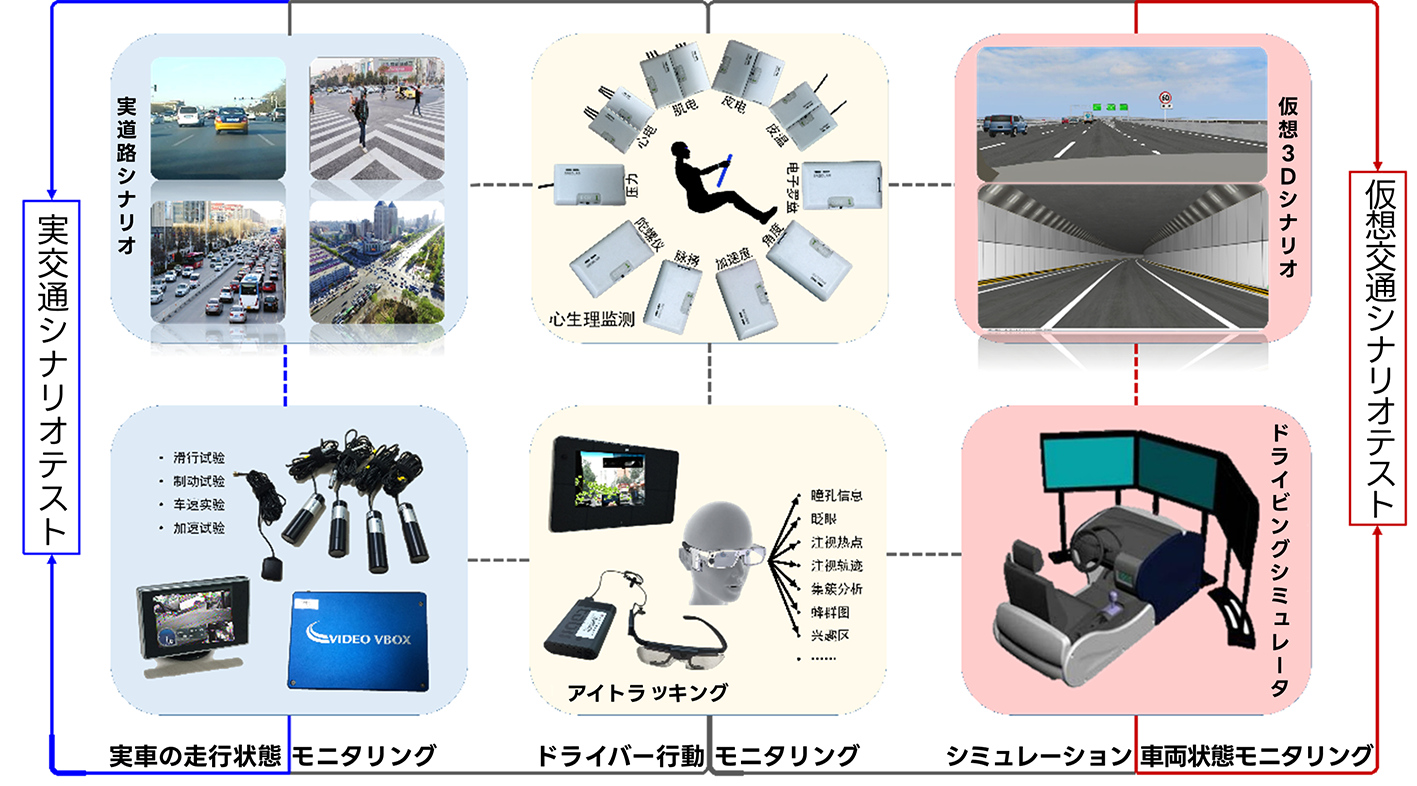
A research platform that integrates real-world traffic data with virtual simulations to monitor driving behaviors and vehicle conditions from multiple angles


VR Applications in Safe Driving Research and Advanced Traffic Control System Research

Research on Identification and Safety Impact Mechanism of Driving Distraction Behavior under Multimodal Information Interference
The research team used UC-win/Road to construct a highly controllable and realistic combined scenario of an urban expressway and an arterial road. The scenario was designed with various dynamic events such as regular traffic flow, random lane-changing vehicles, and pedestrian crossings. Through the platform's programming interface, distraction tasks were precisely triggered and controlled. The quantitative analysis through multimodal data synchronization and fusion revealed the differential patterns of how visual-manual distraction and cognitive distraction affect driving behavior. This research yielded multiple high-level SCI/SSCI papers, providing key support for optimizing warning algorithms and interaction timing.

Human Factors Reliability Testing for Takeover Scenarios in Automated Driving
人Addressing the frontier of human-machine co-driving, the team used UC-win/Road's API to independently develop an automated vehicle control plugin. They constructed various takeover request scenarios in virtual environments, simulating automated vehicle system failures on highways and urban roads. The system evaluated driver takeover performance under different warning methods and varying driver workloads, establishing a takeover reliability prediction model. The results were directly published in high-level domestic and international academic journals, holding significant theoretical value for optimizing the human-machine interface design of intelligent driving systems.

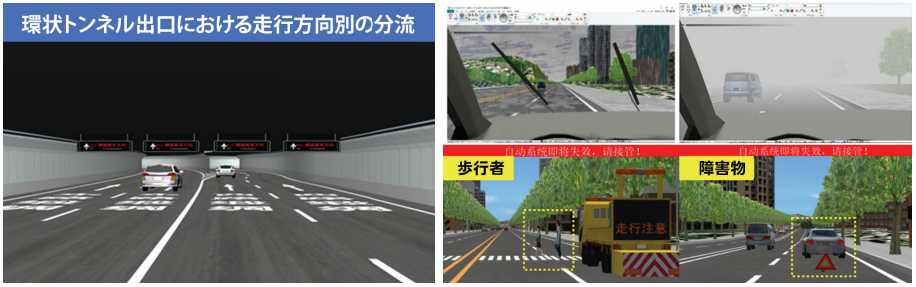
Driving simulation that reproduces multiple traffic scenarios, including traffic flow
at the exit of a circular tunnel, poor visibility, and handling pedestrians and obstacles
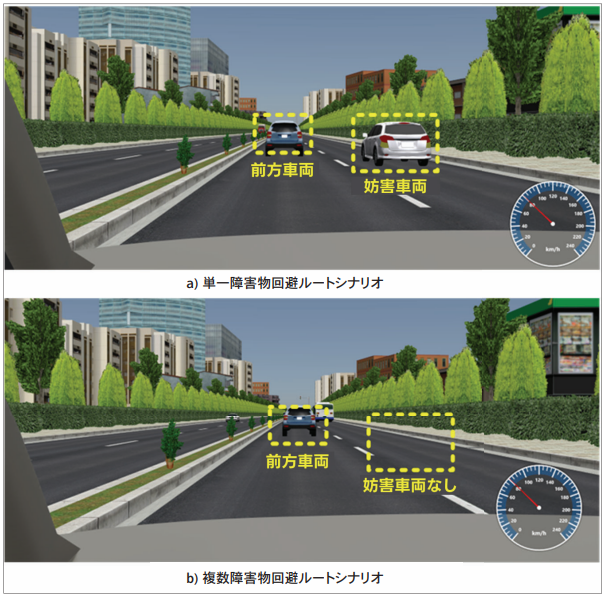
Simulation of avoidance route selection based on the situation of the vehicle ahead and
the presence or absence of obstacles


Applications and Future Prospects of Experiments and Research Using VR

Looking ahead, the Traffic Behavior and Safety Research Team at North China University of Technology has high expectations for the cooperation with FORUM8 and UC-win/Road and has planned a clear blueprint for deepening its application:

Deep System Integration and Upgrades
Explore deeper two-way data connectivity between UC-win/Road and BIM, as well as traffic simulation cores (such as VISSIM/SUMO), to achieve an integrated workflow from design to simulation.

Expanding Research Application Scenarios
Cooperative Vehicle-Infrastructure Systems (CVIS) and Automated Driving Testing : Utilize UC-win/Road's rich scenario editing capabilities to build virtual proving grounds containing various edge cases, serving the simulation verification of intelligent connected vehicle algorithms.
Digital Twin City Research : Attempt to connect real-time traffic flow data to drive the dynamic operation of virtual city models, exploring towards a micro-level "digital twin" transportation system.
Experimental Platform Construction : Plan to establish a "Smart City and Traffic VR Joint Simulation Laboratory", with UC-win/Road at its core, integrated with multi-channel curved screens, VR headsets, motion capture equipment, etc., to create a first-class immersive environment for research and teaching in China.
Course and Teaching Material Development : Plan to develop a series of experimental tutorials or specialized teaching materials related to UC-win/Road based on mature application experience, benefiting more peer institutions.


Research projects using UC-win/Road in Traffic Behavior and Safety Research Laboratory

[1] National Key Research and Development Program of China: Research on Driving Behavior Analysis Technology for Assisted Driving Vehicles Based on Multi-Source Data, 2023-2026

[2] National Key Research and Development Program of China: Heterogeneous Entity Multi-dimensional Interoperability Technology Architecture and Verification Platform Technology, 2022-2025

[3] Project supported by the National Natural Science Foundation of China: Causal Mechanisms and Risk Assessment of Traffic Accidents Based on the Mind-Body-Field Theory, 2016-2018

[4] Beijing Municipal Education Commission Science & Technology Planned General Project: Research on Driver Interaction Characteristics and Accident Risk Early Warning Methods Under Multiple Conflict Types, 2023-2025

[5] Key Project of the Open Fund, Engineering Research Center for Road Disaster Prevention and Traffic Safety, Ministry of Education: Recognition and Modeling of Intersection Driving Intentions Based on Driver Perception, 2022-2024

[6] Beijing Municipal Outstanding Talent Training Program: Cognitive Driving Behavior Patterns and Risk Assessment at Signalized Intersections Based on Visual Characteristics, 2015-2016


(Up&Coming '26 New Year issue)


Index
  

Back
Up&Coming

LOADING