News Release on July 1
FORUM8 Co., Ltd.
Maebashi's participatory urban-development digital twin "MAEP" has been launched.
Joint project by Maebashi Design Commission, QON Co., Ltd., and FORUM8 Co., Ltd.
Maebashi Design Commission (2-1-6 Honmachi, Maebashi City, Gunma Prefecture); Representative Director: Keiichi Uruga; URL: https://www.maebashidc.jp), QON Co., Ltd. (2F Freund MITA, 2-14-5 Mita, Minato-ku, Tokyo; President and CEO Takashi Takeda; URL: https://www.q-o-n.com), FORUM8 Co., Ltd. (2-15-1 Konan, Minato-ku, Tokyo; President and CEO Yuji Ito; URL: https://www.forum8.com) launch MAEP project, a participatory urban‑development digital twin where dialogue continuously updates the vision of the future city.
This project collects and analyzes dialogues among diverse stakeholders in Maebashi City, including citizens, businesses, and visitors, and visualizes the results on a 3D city model to realize a new digital twin* for citizen‑participatory future city co‑creation. It has been developed as a use case of the 3D city model PLATEAU and has been selected for the MLIT’s "FY2026 Urban Spatial Data Digital Infrastructure Development Support Program."
In this project, three organizations with distinct expertise work together to promote a circular urban‑development platform that continuously reflects citizens’ voices in the future city model.
Maebashi Design Commission is responsible for designing questions related to urban development, community building, and dialogue with citizens through the operation of a citizen‑participatory platform "MAEP (Maebashi ENGAWA Platform)". QON leverages its expertise in online community management to analyze dialogue and activity logs, visualize value systems, and structure the data for use in generative AI. FORUM8 utilizes PLATEAU’s 3D city models along with its VR and digital‑twin technologies to build and visualize a future‑city simulation environment "MAEBASHI2099" and develop an immersive interactive system.
Project overview and demonstration experiment
In conventional urban development, future visions are typically created by the government and a small number of experts, while citizens provide feedback through public comment processes. However, this approach has a limitation in that only a very limited number of people can participate. In this project, the future of the city is shaped based on the opinions and discussions of tens of thousands of citizens, and potentially hundreds of thousands as participation grows. AI has made it possible to incorporate the opinions and discussions of tens of thousands—and even hundreds of thousands—of people into urban development. We compare the future city image drawn on the 3D city model with the current city and visualize which citizens’ voices underpin the changes from the present to the future. Citizens can engage in discussions while seeing how their opinions are reflected in the city.
In addition, we will establish a mechanism where the vision for the future city is continuously updated by analyzing citizen feedback and channeling those discussions back into the model. Our goal is not merely to use citizen participation as a tool for gathering feedback, but to transform it into a collaborative process of shaping the future city together.
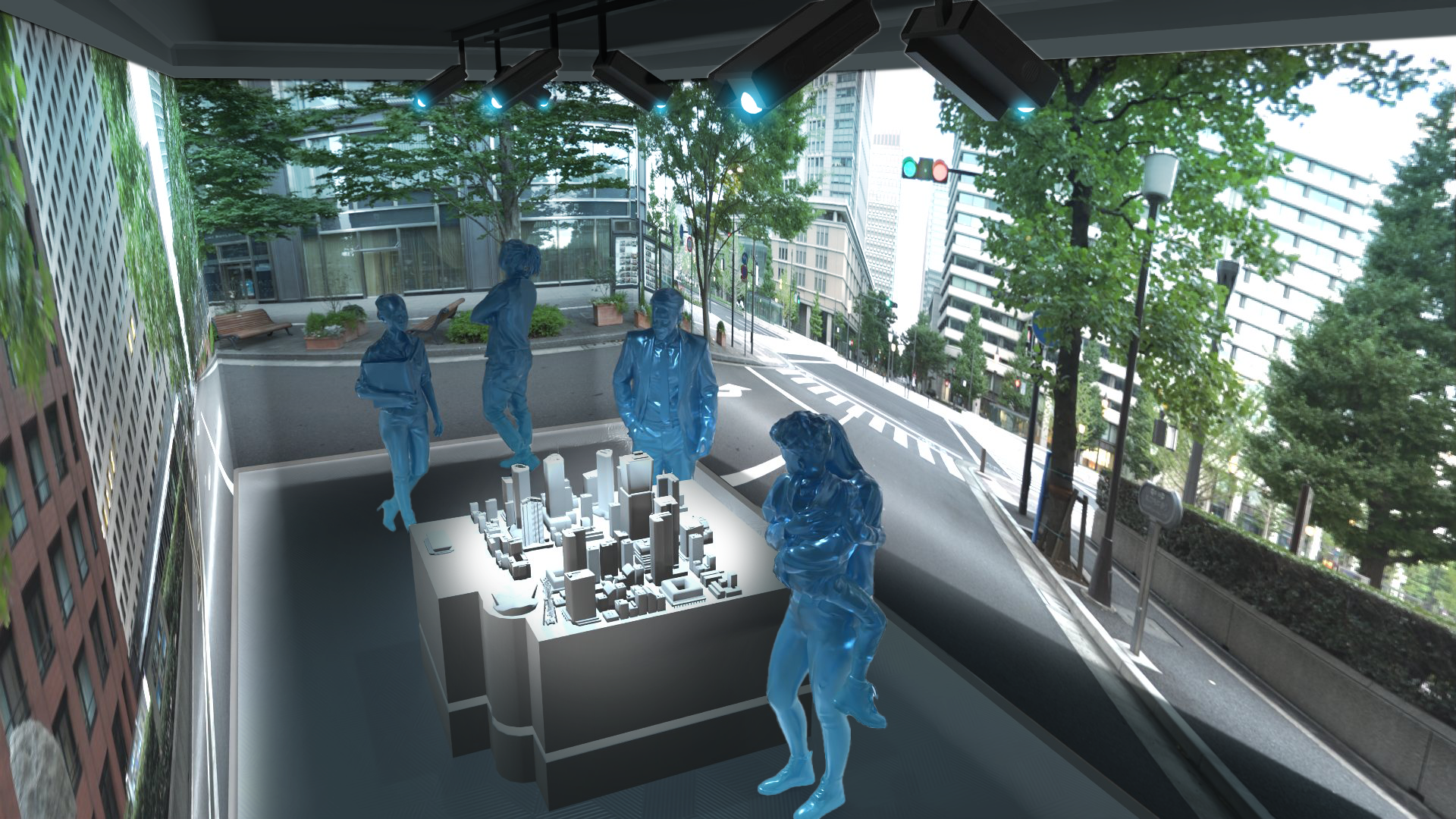
As part of this project, we will conduct a demonstration experiment at the 1st Maebashi International Art Festival (held from September 19 to December 20, 2026). The experiment will showcase an interactive digital twin system, actively inviting participation from both local citizens and visitors. Participants will explore a future city model that reflects the collected opinions and ideas. Within this 3D environment, they can deepen their discussions and provide further feedback to the model. Through this initiative, we will verify the effectiveness of citizen-participatory digital twins.
Future Plans
Our project aims to upgrade citizen participation from a simple feedback collection system into a collaborative platform for co-creating the future city. Using Maebashi City as a model case, we will establish a new participatory community development method that integrates citizen voices into the vision for the future city. Looking ahead, we aim to roll out this model to local governments and regions across Japan, contributing to sustainable urban development and the revitalization of local communities.
* Digital Twin: A technology that replicates real-world phenomena within cyber space.


